
Paycheck Calculator NZ Results
Your result separates gross earnings from the main deductions that can reduce the amount you receive.
Gross Pay
Gross pay is your earnings before payroll deductions. Depending on your job, it may include salary, wages, overtime or other taxable payments.
PAYE Income Tax
PAYE is the tax deducted from salary and wages by your employer and paid to Inland Revenue. The amount depends on your income, tax code and the applicable payroll rules.
ACC Earners’ Levy
The ACC earners’ levy is collected through the PAYE system for employees. For the 2026/27 tax year, the rate is 1.75% on liable earnings up to $156,641, giving a maximum annual levy of $2,741.22.
KiwiSaver Contributions
If you contribute to KiwiSaver through your employer, your employee contribution is deducted from your pay. From 1 April 2026, the default employee rate is 3.5%. Available employee rates are 3.5%, 4%, 6%, 8% and 10%. A temporary reduction to 3% may also be available if you meet the requirements.
Student Loan Repayments
If you have a New Zealand student loan and your income is above the applicable threshold, repayments can be deducted from your wages. For the 2026/27 tax year, the annual repayment threshold is $24,128 and the primary income repayment rate is 12% on income above the threshold.
Net Pay and Take Home Pay
Net pay is the amount remaining after the applicable deductions included in the calculation. It is generally the figure closest to what reaches your bank account, although your actual payslip can include deductions or adjustments that the calculator does not include.
How Our Paycheck Calculator NZ Works
Enter Your Gross Pay
Enter the amount you earn before deductions. You can start with an annual salary or another supported pay amount.
For hourly workers, your gross earnings can be based on your hourly rate and hours worked.

Choose Your Pay Frequency
Select the period that matches your employment arrangement.
- Common options include:
- Weekly
- Four weekly
- Fortnightly
- Monthly
- Annual
- Hourly, where supported
- Inland Revenue publishes separate PAYE deduction tables for weekly, fortnightly, four weekly and monthly pay periods.
Select Your Tax Code
Your tax code tells your employer how to calculate deductions from your income. A person with one main source of employment may use a main income tax code, while someone with more than one taxable income source may need a secondary tax code.
Add KiwiSaver Contributions
Select your employee contribution rate if you contribute through payroll. The standard employee options from 1 April 2026 are 3.5%, 4%, 6%, 8% and 10%.
Review Your Take Home Pay
The calculator shows how your gross earnings change after the deductions included in the calculation. Use the result as an estimate of the amount available for spending or saving
Add Student Loan Repayments
If you have a student loan, select the applicable student loan setting. Your repayment can depend on whether the income is from your main job or a secondary source.
How Is Pay Calculated in New Zealand?
Gross pay
PAYE and ACC deductions
Other applicable deductions
Net pay
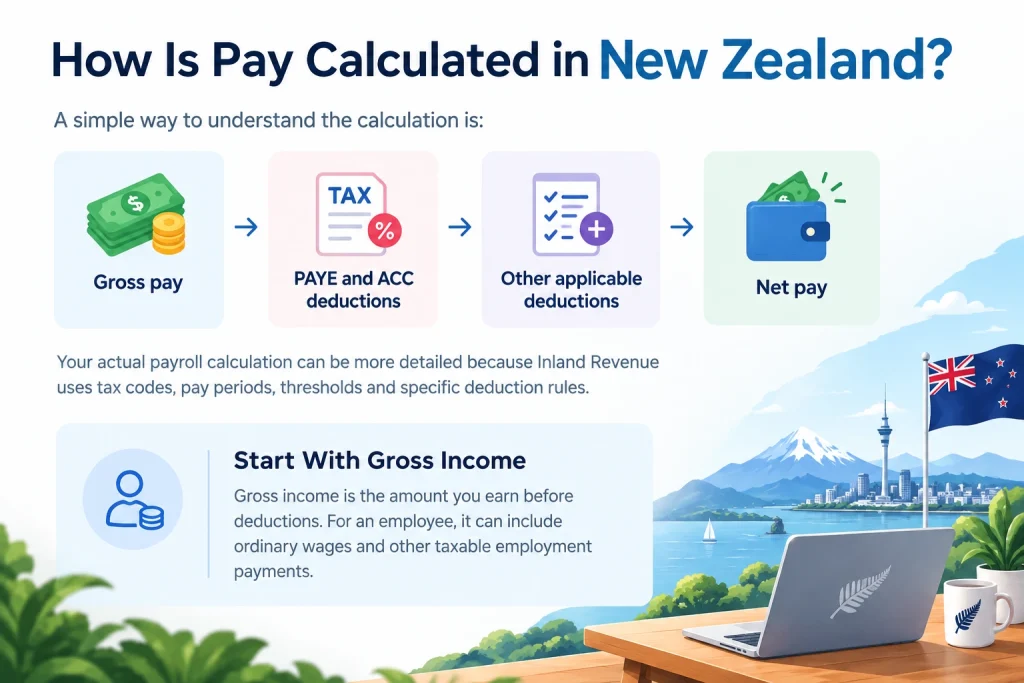
Your actual payroll calculation can be more detailed because Inland Revenue uses tax codes, pay periods, thresholds and specific deduction rules.
Start With Gross Income
Gross income is the amount you earn before deductions. For an employee, it can include ordinary wages and other taxable employment payments.
Calculate PAYE
New Zealand uses progressive income tax rates. Different portions of taxable income are taxed at different rates.
For the 2026/27 tax year, the individual income tax rates are:
Taxable income | Income tax rate |
$0 to $15,600 | 10.5% |
$15,601 to $53,500 | 17.5% |
$53,501 to $78,100 | 30% |
$78,101 to $180,000 | 33% |
Over $180,000 | 39% |
These rates apply to the relevant portion of your income. Moving into a higher bracket does not mean your entire salary is taxed at that higher rate.
Apply the ACC Earners’ Levy
For 1 April 2026 to 31 March 2027, the ACC earners’ levy is 1.75% on liable earnings up to $156,641. The levy is collected with PAYE, although a calculator or pay slip may show the ACC amount separately to make the deduction easier to understand.
Apply KiwiSaver Contributions
If KiwiSaver applies to you, your employee contribution is calculated from the relevant gross pay used for KiwiSaver purposes. From 1 April 2026, the default employee rate is 3.5%.
Apply Student Loan Deductions
For the 2026/27 tax year, the student loan repayment threshold is $24,128 annually. For primary income, 12% applies to earnings above the relevant threshold. The corresponding threshold is $464 weekly, $928 fortnightly, $1,856 four weekly and $2,010.66 monthly.
Calculate Net Pay
Once the applicable deductions have been accounted for, the remaining amount is your estimated net pay.
NZ Income Tax Rates and PAYE
New Zealand’s income tax system is progressive. Your marginal tax rate is the rate that applies to the next portion of taxable income. It is not the same as the percentage of your entire salary that you pay in income tax.
How NZ Income Tax Brackets Work
Imagine part of your taxable income reaches the 30% bracket. Only the income within that bracket is taxed at 30%. Income in the lower brackets continues to use the lower rates.This is why earning more does not cause your whole salary to suddenly be taxed at the highest rate.
Marginal Tax Rates
The marginal rate applies to the next dollar or portion of income within the relevant tax band. Your effective income tax rate is different. It compares your total income tax with your total taxable income.
Your Tax Code
Your employer uses your tax code to work out how much PAYE to deduct.If you have one main source of salary or wages, your circumstances may allow a main income tax code. If you receive taxable income from more than one source at the same time, a secondary tax code may apply. If you do not provide your employer with the required tax code declaration, Inland Revenue says the non declaration rate can apply.
Main Income and Secondary Income
Secondary tax is not an extra tax that sits on top of your normal income tax.When you have more than one taxable income source, a secondary tax code helps account for the fact that your combined income may reach a higher tax bracket. Inland Revenue provides secondary codes such as SB, S, SH, ST and SA based on estimated total annual income.
What Is Deducted From Your Pay?
Not every employee has the same deductions. Your pay slip depends on your circumstances and the instructions given to your employer.
PAYE Tax
PAYE is the main tax deduction from salary and wages. Your employer deducts it before paying you and sends it to Inland Revenue.
KiwiSaver
If you contribute through payroll, your employee Kiwi Saver contribution reduces the amount you receive in your bank account. From 1 April 2026, the default employee contribution is 3.5%. Your employer’s Kiwi Saver contribution is separate from your employee deduction. The minimum compulsory employer contribution is also 3.5%, although employer contributions can be affected by ESCT and other rules.
Student Loan Repayments
A student loan deduction can reduce your net pay once your income is above the relevant repayment threshold.
ACC Earners’ Levy
The ACC earners’ levy is collected through the PAYE system. For 2026/27, it is 1.75% of liable earnings up to the annual maximum.
Other Payroll Deductions
Depending on your circumstances, your payslip may contain other deductions. These can include child support, payroll giving, additional student loan deductions or other amounts required or authorised through payroll.
Gross Pay vs Net Pay
Gross pay is your earnings before the deductions taken through payroll.
Net pay is the amount remaining after applicable deductions.
Take home pay is the amount you actually receive after the deductions applied to your pay.For most employees, this is the figure that matters when working out how much money is available for rent, groceries, transport, bills and savings.
Your advertised salary is normally a gross amount. PAYE, ACC, KiwiSaver, student loan repayments and other applicable deductions can reduce the amount paid into your bank account.
Calculate Your Pay by Frequency
Annual Salary
Annual salary is your gross earnings over the relevant year before deductions.
Monthly Pay
Monthly pay represents your earnings for a monthly payroll period. Dividing an annual salary by 12 can provide a basic monthly figure, but actual payroll deductions should be calculated using the applicable monthly rules.
Fortnightly Pay
Fortnightly pay covers a two week period. There are 26 fortnightly periods in a standard year, although payroll timing can affect how annual salary is distributed.
Weekly Pay
Weekly pay covers one week of earnings. PAYE and student loan deductions use the relevant weekly thresholds and payroll tables.
Hourly Pay
Hourly workers can estimate gross earnings by multiplying their hourly rate by the hours worked. Overtime, allowances and other payments can change the final amount.
How Much Tax Is Taken From Your Paycheck?
There is no single percentage that applies to every employee.
Your PAYE deduction can depend on:
- Gross income
- Tax code
- Pay frequency
- ACC levy
- Student loan status
- Kiwi Saver contribution
- Other applicable payroll deductions
- For example, two employees earning the same salary can receive different take home pay if one has a student loan or makes Kiwi Saver contributions and the other does not. The most useful estimate comes from entering your own pay and deduction settings into the calculator.
Understanding PAYE on Your Payslip
Your pay slip provides the actual result from your employer’s payroll system. You can use it to compare your real deductions with a calculator estimate.
Where to Find Gross Pay
Look for a line such as gross pay, gross earnings or gross wages. This is the amount before the relevant payroll deductions.
Where to Find PAYE
PAYE should appear as a deduction from your salary or wages. Some payroll systems may present PAYE and ACC together, while others show the components separately.
Where to Find ACC
Your payslip may show the ACC earners’ levy separately or as part of the overall PAYE deduction.
Where to Find Gross Pay
Look for a line such as gross pay, gross earnings or gross wages. This is the amount before the relevant payroll deductions.
Understanding YTD Payslip Figures
YTD means year to date. A YTD figure shows the accumulated amount recorded by payroll over the relevant period. For example, a pay slip may show YTD gross earnings and YTD PAYE. These figures are useful when checking how much you have earned and how much has already been deducted.
Why Your Payslip May Differ From the Calculator
A calculator may not reproduce every payroll situation.
Your actual pay slip can differ because of:
Inland Revenue’s own PAYE calculator explains that some situations require separate treatment, including certain lump sum payments, special deduction rates, tailored tax codes and other non standard payroll situations.
If your payslip differs from an estimate, check the pay period, tax code and deductions before assuming there is a payroll error.
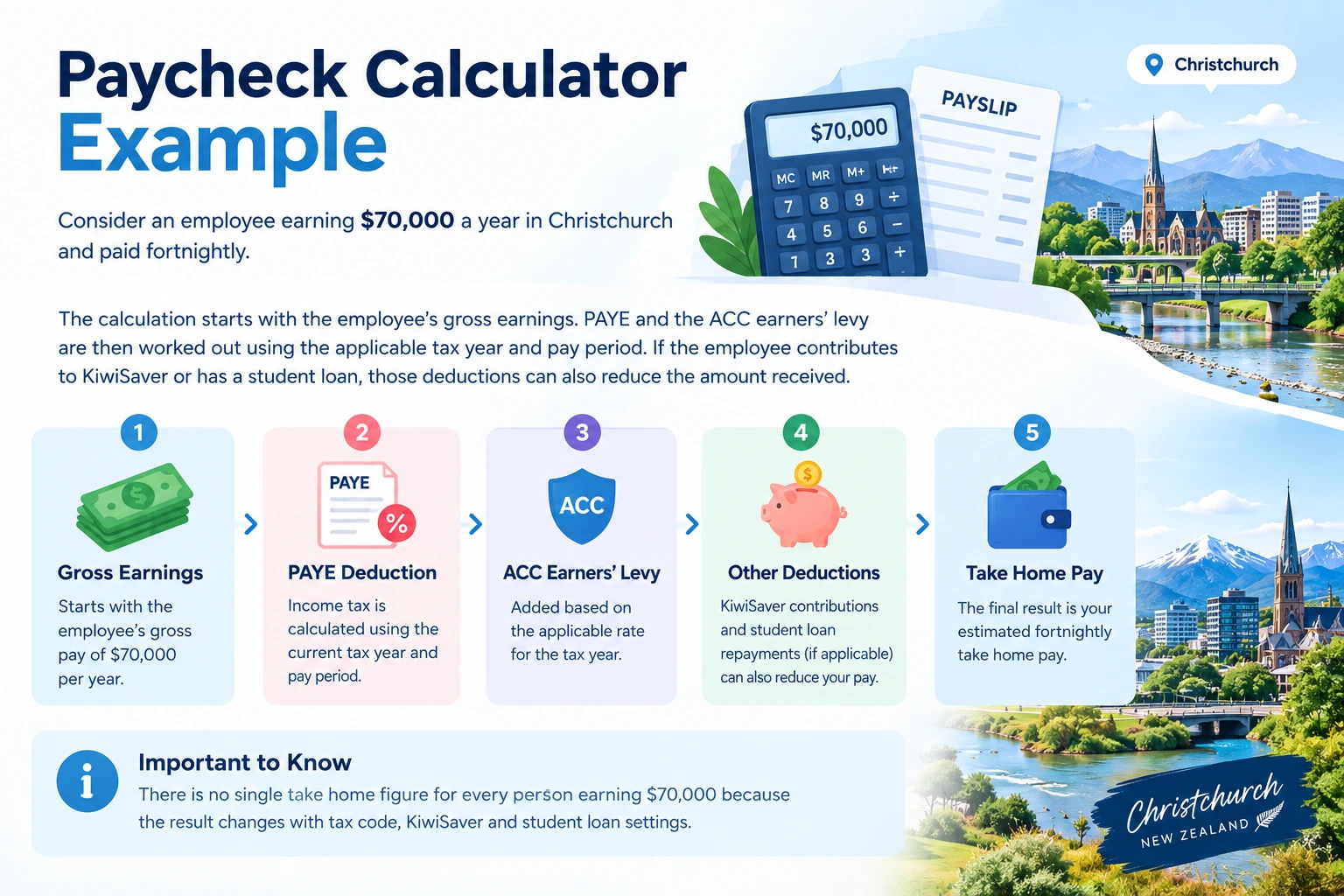
Paycheck Calculator Example
Consider an employee earning $70,000 a year in Christchurch and paid fortnightly.
The calculation starts with the employee’s gross earnings. PAYE and the ACC earners’ levy are then worked out using the applicable tax year and pay period. If the employee contributes to KiwiSaver or has a student loan, those deductions can also reduce the amount received.
The final result is the estimated fortnightly take home pay.There is no single take home figure for every person earning $70,000 because the result changes with tax code, KiwiSaver and student loan settings.
Paycheck Calculator FAQs
Related NZ Pay and Tax Calculators
Use a more specific calculator when your situation requires a different calculation.
PAYE Calculator NZ
Calculate PAYE and related employee deductions using NZ tax settings.
Salary Calculator NZ
Convert salary information into common pay periods and estimate deductions.
Take Home Pay Calculator
Focus on the amount left after applicable payroll deductions.
Payslip Calculator
Break down gross earnings, deductions and estimated net pay.
Pay Deduction Calculator
Estimate specific deductions from salary or wages.
Overtime Calculator NZ
Estimate additional earnings from overtime hours.
Pro Rata Salary Calculator
Work out salary for part time hours compared with a full time role.
KiwiSaver Calculator
Estimate employee and employer KiwiSaver contributions.
Student Loan Calculator
Estimate student loan repayments based on applicable income thresholds.
Sources, Tax Year and Calculator Assumptions
Tax Year Used by the Calculator
This page is written for the 2026/27 New Zealand tax year, covering 1 April 2026 to 31 March 2027.
The individual income tax rates are 10.5%, 17.5%, 30%, 33% and 39% across the applicable income bands.
The ACC earners’ levy is 1.75% for 2026/27, with liable earnings capped at $156,641.
The default KiwiSaver employee contribution rate is 3.5% from 1 April 2026. Employees can choose 4%, 6%, 8% or 10%, and eligible members can apply for a temporary 3% rate reduction.
The student loan repayment threshold for the 2026/27 payroll year is $24,128 annually, with primary income repayments calculated at 12% above the applicable threshold.
Official NZ Sources
The primary sources for this calculator are:
Inland Revenue publishes the current PAYE deduction tables and tax rates used for employee payroll calculations.
What the Calculator Does Not Include
A general paycheck calculator cannot reproduce every possible payroll situation.
Results may not cover special tax treatment for certain lump sum payments, tailored tax codes, special student loan deduction rates, schedular payments or other unusual payroll circumstances.
For a straightforward salary or wage calculation, the tool provides a useful estimate. For a complex payroll situation, compare the result with your payslip and the current Inland Revenue guidance.
Tax information reviewed for the 2026/27 New Zealand tax year. Tax rates, payroll thresholds and contribution rules can change, so the calculator should be updated when Inland Revenue or ACC publishes new rates.
You have not enough Humanizer words left. Upgrade your Surfer plan.