The calculator is designed for common New Zealand salary and wage situations, including weekly, fortnightly, four weekly, monthly and annual income.
Your actual payslip can differ if you have a different tax code, student loan, KiwiSaver rate, secondary income or other deductions.
Your PAYE Calculation
Your result shows how your gross income can change into the amount you receive after tax and other selected deductions.
Gross Income
Gross income is your pay before PAYE and other deductions are taken out. This can be shown as an annual salary, monthly pay, fortnightly pay, weekly pay or another pay period supported by the calculator.
PAYE & Income Tax
PAYE means Pay As You Earn. Employers generally deduct PAYE from salary and wages and pay it to Inland Revenue on your behalf. New Zealand uses progressive income tax rates. This means different portions of your income can be taxed at different rates.
ACC Earners’ Levy
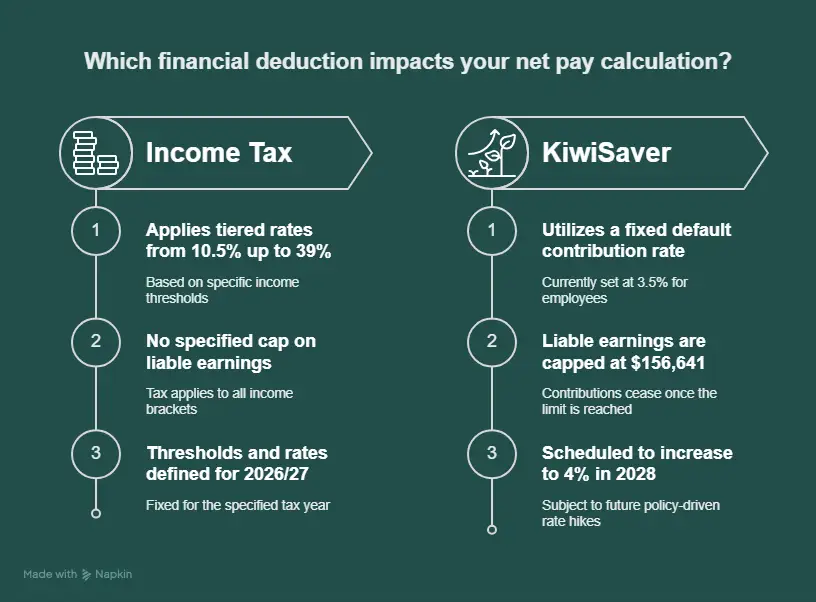
The ACC earners’ levy is collected through PAYE for most employees. For the 2026/27 tax year, the rate is 1.75% on liable earnings up to $156,641, with a maximum levy of $2,741.22.
This means your PAYE related deductions can include both income tax and the ACC earners’ levy.
KiwiSaver Contributions
If you are enrolled in KiwiSaver, an employee contribution can be deducted from your pay.
From 1 April 2026, the standard default employee contribution rate is 3.5%. Employees can choose 4%, 6%, 8% or 10%, subject to the applicable rules. A temporary reduction to 3% may also be available in some circumstances.
Your payslip may also include other deductions depending on your situation.
individual income tax rates for 2026/27
| Taxable income | Income tax rate |
| $0 to $15,600 | 10.5% |
| $15,601 to $53,500 | 17.5% |
| $53,501 to $78,100 | 30% |
| $78,101 to $180,000 | 33% |
| Over $180,000 | 39% |
These rates apply to the relevant portions of taxable income, not the whole salary at one rate. Moving into a higher tax band does not mean all of your income is taxed at that higher rate.
Your KiwiSaver contribution affects the amount you receive in your bank account, but it is not the same thing as PAYE income tax.
Student Loan Repayments
If you have a New Zealand student loan, repayments may be deducted from your pay when your income is above the relevant repayment threshold.
Your tax code can include the student loan deduction. If your circumstances change, such as paying off the loan or starting a different job, you may need to update your tax code.
How PAYE Is Calculated in New Zealand
PAYE is based on your taxable earnings, pay period and tax code. Your employer uses the information you provide to determine the appropriate deductions. The calculation is progressive. Your income is divided across tax bands, with each portion taxed at its applicable rate.
Your pay frequency also matters when calculating the amount deducted from an individual pay. Inland Revenue publishes PAYE deduction tables for weekly, fortnightly, four weekly and monthly payments. To estimate your tax return use tax refund calculator.
NZ Income Tax Rates and Tax Brackets
New Zealand’s income tax system has several tax bands.
For 2026/27, the highest marginal rate is 39% for taxable income above $180,000. This does not mean someone earning more than $180,000 pays 39% on their entire income.
For example, a person earning $100,000 has different portions of income taxed at different rates. The result is an effective tax rate that is lower than the highest marginal rate applying to the top portion of income.
For a detailed breakdown, see our NZ Tax Rates and Tax Brackets Guide.
Your PAYE Tax Code
Your tax code tells your employer or other payer how much tax to deduct from your income. Your circumstances determine the code you should use. Your main income may use a different code from a second income source.yu
IRD explains that people receiving taxable income from more than one source may need a secondary tax code. The correct code helps the payer deduct an appropriate amount during the year.
Common tax codes include M, ME, SB, S, SH, ST and SA, depending on your circumstances. If your job, income, student loan or other circumstances change, your tax code may also need to change.
For help choosing a code, see our NZ Tax Code Calculator and Guide.
Weekly, Fortnightly, Four Weekly and Monthly Pay
PAYE can be calculated for different pay periods.
Our calculator can help you estimate your take home pay from the income you receive each pay period. Inland Revenue’s own PAYE calculator also supports weekly, fortnightly, four weekly and monthly pays.
If you are paid hourly, first work out your gross pay for the relevant period. You can then use that amount for the PAYE calculation. For hourly to salary conversions, see our Hourly Rate to Salary Calculator.
What Is PAYE?
PAYE stands for Pay As You Earn.
It is the system used to collect income tax from many employees as they receive salary or wages. Your employer deducts the required amount from your pay and sends it to Inland Revenue.
PAYE is not simply a flat percentage of your salary. The amount depends on your taxable income, tax code, pay period and other relevant circumstances. Inland Revenue states that tax codes help employers work out how much tax to deduct from salary, wages, benefits and pensions.
What Is Deducted From Your Salary?
Your payslip can contain several deductions. Not every employee has the same deductions.
PAYE Income Tax
This is the income tax deducted from your salary or wages under the PAYE system. The amount depends on your income and tax code.
ACC Earners’ Levy
The ACC earners’ levy helps fund injury cover for earners in New Zealand. For 2026/27, the levy is 1.75% up to the annual earnings maximum set by Inland Revenue.
KiwiSaver
Normally deducted from your pay if you are an employee who contributes to a scheme. From 1 April 2026, the default employee contribution rate is 3.5%.
Student Loan
Student loan deductions apply when the relevant rules and income thresholds require them. Your tax code can tell your employer to make these deductions.
PAYE Calculator Examples
Your exact result depends on the information entered into the calculator, including your tax code and selected deductions.These salary examples are useful for understanding the type of calculation the tool performs.
$50,000 Salary After Tax
A $50,000 salary crosses the first income tax threshold, so different portions of the income are taxed at different rates.
Your take home amount will also depend on factors such as KiwiSaver and student loan deductions.
$60,000 Salary After Tax
At $60,000, part of the income falls into the 30% tax band. The entire salary is not taxed at 30%.
The calculator separates the income across the applicable tax bands.
$80,000 Salary After Tax
An $80,000 salary reaches the 33% tax band for the portion above $78,100 under the 2026/27 rates.
The final take home amount depends on the deductions that apply to you.
$100,000 Salary After Tax
At $100,000, the income is spread across several tax brackets. Your marginal tax rate applies only to the top portion within the relevant band.
Use the calculator to see the estimated PAYE and take home the amount for your circumstances.
PAYE for Different Work Situations
Secondary Jobs and Secondary Tax
If you have more than one taxable income source, you may need a secondary tax code.
IRD explains that secondary tax codes help a payer account for income from another source because the payer may not know your total annual income.
For a detailed calculation, see our Secondary Tax Calculator NZ.
Overtime and Bonuses
Overtime and bonuses can increase your taxable income and may change the deductions taken from a particular payment.
A bonus or other lump sum can have specific PAYE calculation rules. Inland Revenue provides separate guidance for lump sum payments.
For a detailed bonus calculation, use our PAYE Calculator With Bonus.
Casual and Part Time Work
Part time employees are generally taxed through PAYE in the same way as other employees, but the amount deducted depends on their income, pay period and tax code.
Casual workers can have different tax code requirements depending on the type of work and their circumstances.
NZ PAYE and Tax Changes for 2026/27
The New Zealand tax year runs from 1 April to 31 March.
For 2026/27, the individual income tax thresholds are $15,600, $53,500, $78,100 and $180,000. The corresponding marginal rates are 10.5%, 17.5%, 30%, 33% and 39%.
The ACC earners’ levy for the same year is 1.75%, with liable earnings capped at $156,641.
KiwiSaver also changed from 1 April 2026. The default employee contribution rate increased from 3% to 3.5%. The planned default rate is scheduled to increase to 4% from 1 April 2028.
These details matter when comparing an online PAYE estimate with an actual payslip.
Frequently Asked Questions About NZ PAYE
Sources and Calculation Information
This calculator is designed to provide an estimate based on the information entered.
New Zealand payroll rules can change, and individual circumstances can affect the final amount deducted from your pay. For official information, refer to Inland Revenue for PAYE, tax codes, tax rates and KiwiSaver rules, and ACC for injury cover information.
The main official sources used for this page include Inland Revenue’s PAYE calculator, individual tax rates, tax code guidance, KiwiSaver contribution rules and ACC earners’ levy information.