
Estimate Your Tax Refund
Enter your total income for the year and the PAYE tax already deducted from your pay. Pick the tax year you want to check and tell us if you may qualify for the Independent Earner Tax Credit. If you worked more than one job, add up the income and PAYE from every employer first.
The calculator compares your PAYE against your likely income tax and ACC earners levy for the year. It gives you a quick estimate of a refund or a bill. Your confirmed result always comes from.
How Tax Refunds Work in New Zealand
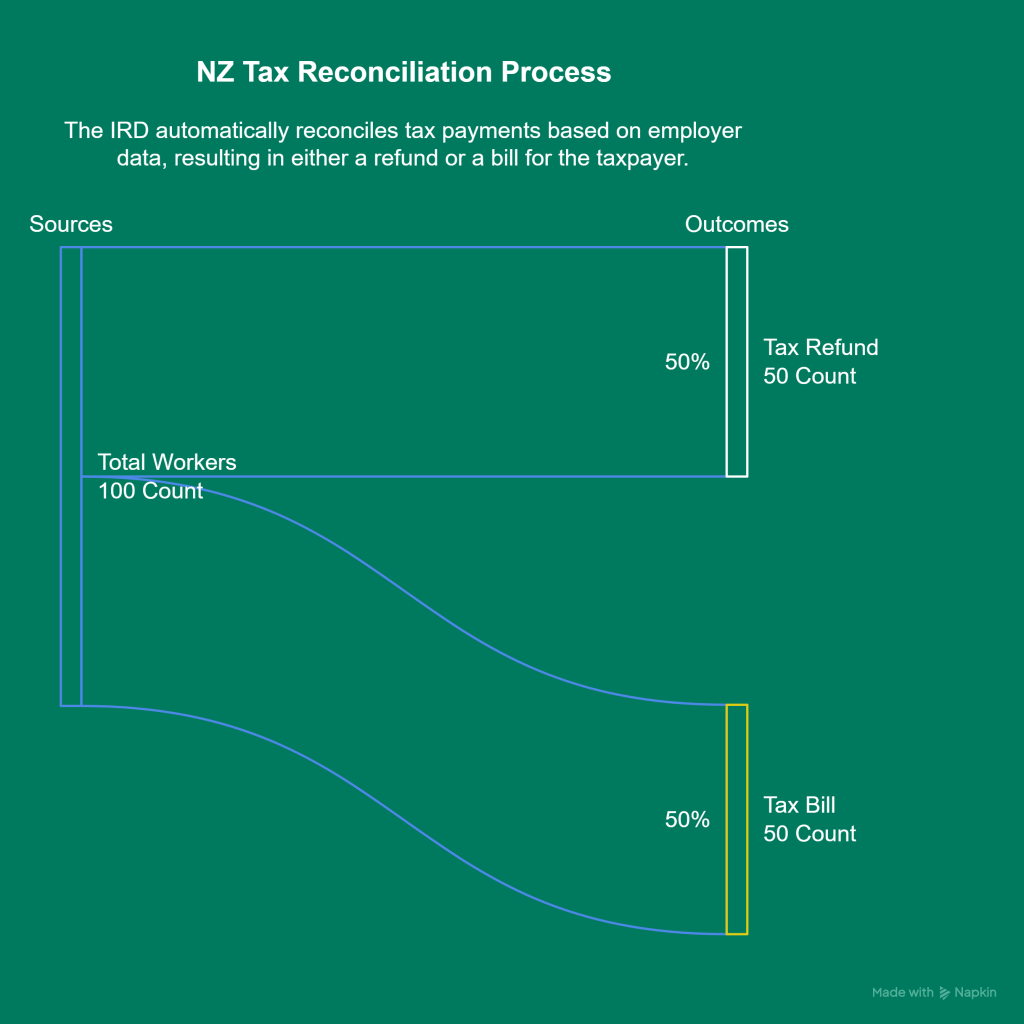
The tax year runs from 1 April to 31 March. Once it ends, IRD checks what you actually earned against the PAYE your employer deducted. If your employer took out too much, you get a refund. If they took out too little, you get a bill.
This happens on its own for most workers, whether you clock in at a warehouse near Ōtāhuhu or work retail on Cashel Street in Christchurch. You do not need to fill out a form to start the process. IRD works it out from the pay data your employer already sends through.
Why You Might Get a Refund
A refund usually means too much tax came out of your pay. Common causes include changing jobs partway through the year, being on the wrong tax code, working only part of the year, or having a gap without income.
Students juggling shifts around exam time at Otago University or Waikato University often see this, since a busy week can push their pay onto a higher tax code than their yearly earnings actually need.
Why You Might Owe Tax
The opposite can also happen. If you held two jobs at once, such as a cafe shift on Cuba Street plus weekend work at a supermarket, each employer may tax you as if that job was your only income.
This can leave you slightly under taxed, and IRD will ask for the difference after 31 March. New Zealand has secondary tax codes to help reduce this gap, but a mismatch can still occur.
New Zealand Income Tax Rates
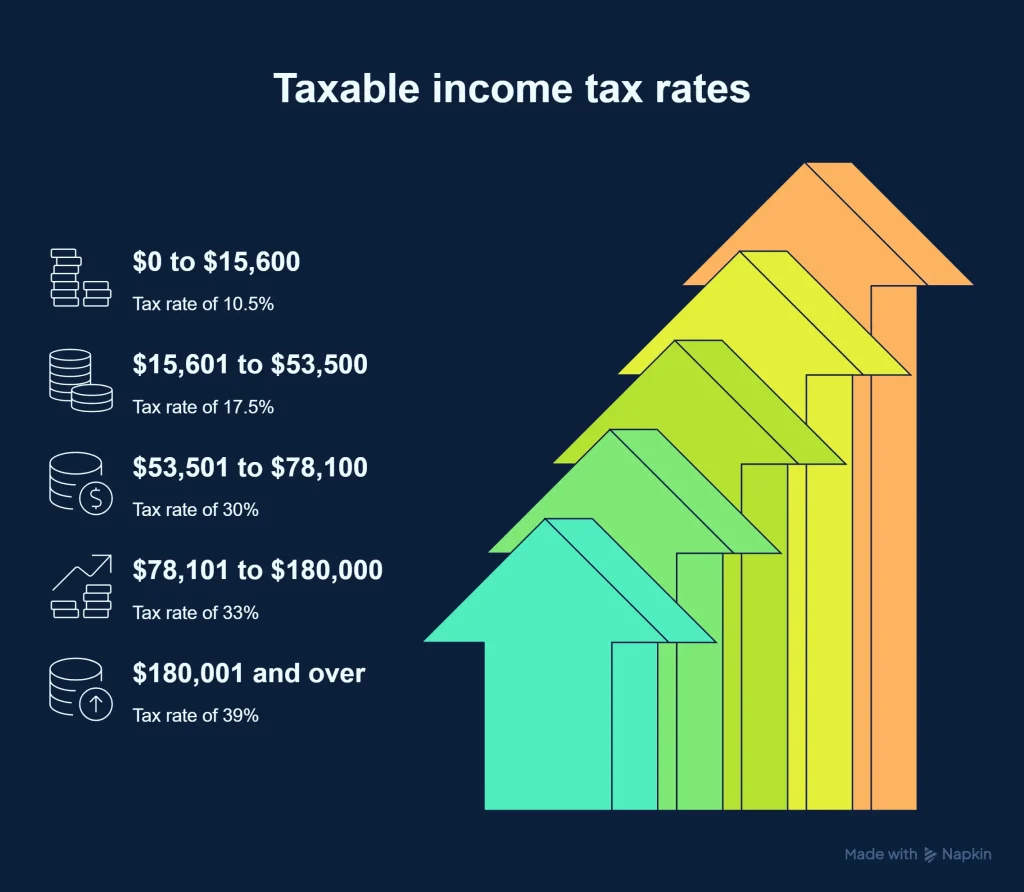
New Zealand taxes income in steps, called brackets. You only pay the higher rate on the part of your income inside that bracket, not on everything you earn.
For the 2025 to 26 and 2026 to 27 tax years, the rates are:
Taxable income | Tax rate |
|---|---|
$0 to $15,600 | 10.5% |
$15,601 to $53,500 | 17.5% |
$53,501 to $78,100 | 30% |
$78,101 to $180,000 | 33% |
$180,001 and over | 39% |
Source: IRD tax rates for individuals
On top of income tax, most employees also pay the ACC earners levy. This rose from 1.67% to 1.75% on 1 April 2026, with the earnings cap rising to $156,641. The most anyone pays in a year is $2,741.22.
Worked Example
Say someone earned $58,000 in the 2026 to 27 tax year and had $11,000 taken out in PAYE.
Their income tax works out to about $9,620.50 across the three brackets that apply. Add the ACC levy at 1.75% of $58,000, which is $1,015. Total tax and levy owed comes to roughly $10,635.50.
Since $11,000 was already deducted, they would be due a refund of about $365, before any extra credits or other income are added in. This is only an example. Your real result depends on everything IRD holds on file for you.
When Will You Get Your Refund
IRD usually issues automatic assessments between May and July, once the tax year has closed. Most refunds are paid straight into the bank account IRD has on record, often within a few weeks of the assessment landing.
Checking Your Refund in myIR
Log into your myIR account to see your assessment and track your refund. Keep your bank details current, especially if you have moved between places like Hamilton and Tauranga during the year, so your payment does not get held up.
Common Reasons People Overpay Tax
Getting the wrong tax code is the most common reason for an overpaid year. Working only part of the year, taking parental leave, or holding two jobs at once can also throw off your final numbers. This applies just as much to seasonal fruit pickers around Hastings as it does to office staff in the Wellington CBD.
You might also be missing the Independent Earner Tax Credit. It is worth up to $520 a year if your income falls between $24,000 and $70,000, you are not on a benefit or Working for Families, and you are not receiving NZ Super. The full credit applies up to $66,000 of income, then it reduces by 13 cents for every dollar earned above that, reaching zero at $70,000.
Do You Need to File an IR3?
Most wage and salary earners never file an Individual Income Tax Return, known as an IR3. IRD assesses you automatically if your only income is salary, wages, or interest that already had tax deducted correctly.
You will usually need to file an IR3 yourself if you earned more than $200 before tax from something with no tax taken out, such as self employment, rental income, or money earned overseas. You will also need to file if your tax residency changed partway through the year.
Is This Calculator Accurate?
This tool gives a solid estimate based on current IRD rates. It cannot fully match your official assessment, which accounts for every detail IRD holds, including interest, dividends, student loan repayments, and Working for Families. Treat this as a planning tool, and check your myIR account for your confirmed figure.